

Project Management
Project Management Overview
Infosec Advisory helps organizations plan and deliver IT projects that address business needs, streamline operations, and integrate systems.
Successful IT projects require clear objectives, coordinated teams, and control over scope, schedule, resources, and cost. These disciplines become especially important when several departments, vendors, or related projects are involved.

As an independent consulting firm, we combine business knowledge with IT delivery experience to help you select suitable solutions and manage implementation.
We help define requirements, prepare requests for proposals, evaluate vendors, and coordinate delivery. Our advice is based on your business objectives and technical needs. Support can cover the full project lifecycle or the specific stages where you need assistance.
Project Management Service Offerings
Managing Project Delivery
- Scope Management
- Define the project’s objectives, deliverables, success criteria, assumptions, and constraints before work begins.
- Schedule Management
- Develop a work breakdown structure (WBS), identify task dependencies, and manage milestones and progress against the agreed schedule.
- Communication Management
- Define how business teams, IT teams, vendors, and other stakeholders communicate. Provide timely updates on progress, decisions, risks, and issues.
Align project priorities with business, executive, and IT requirements.
Managing Resources, Costs, and Governance
- Resource Management
- Identify the skills and capacity required, assign responsibilities, and monitor resource availability throughout the project.
- Cost Management
- Plan and track the project budget, explain variances, and support approvals for expenditure and changes.
- Governance Management
- Establish decision-making responsibilities, escalation routes, and management reporting so the project has the resources and direction it needs.
Project Management Flow
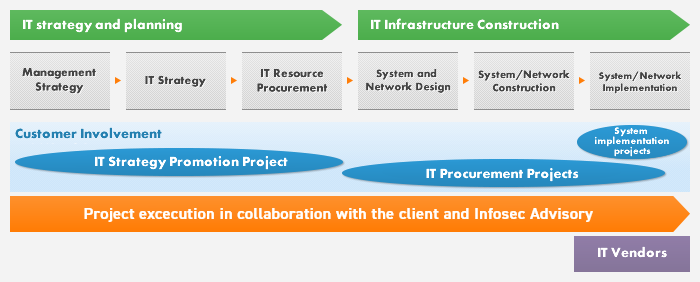
Support Across the IT Project Lifecycle
- Step 1: Business Strategy
- Analyze the internal and external environment, identify business challenges, and define the objectives and priorities that the IT project should support.
- Step 2: IT Strategy
- Review relevant technology trends and develop an IT strategy that supports business objectives and operational efficiency.
- Step 3: IT Procurement
- Prepare requests for information and proposals, define requirements and evaluation criteria, support vendor and service-level discussions, and develop an implementation schedule.
- Step 4: System and Network Design
- Prepare architecture and detailed design documents, configuration procedures, and plans for operations and monitoring.
- Step 5: Build and Test
- Coordinate configuration, define acceptance criteria, prepare test plans and procedures, and support unit and integration testing.
- Step 6: Deployment
- Coordinate installation, migration, parallel operation where required, and the transition to production.
- Step 7: Maintenance and Operations
- Define maintenance activities, incident triage, vendor escalation, and operational responsibilities for servers, networks, hardware, and middleware.
- Step 8: IT Outsourcing
- Review operating costs and outsourcing options, clarify internal and vendor responsibilities, and prepare procedures for routine operations and incident response.
Please feel free to contact us for professional consultation.
