

Security Audit Services
SCS Assessment Scheme ★3 & ★4 / NIST SP 800-171 / Customer Framework Audits
We review policies, evidence, technical configurations, and supplier management practices to deliver an audit report and improvement roadmap that you can confidently present to your customers.
Proposal Summary
Our evidence-based security audit service supports supply-chain requirements, NIST standards, and customer-specific criteria.
Purpose of a Security Audit
We turn assumed security measures into a defensible, evidence-backed position that can be explained to customers, management, and assessors.
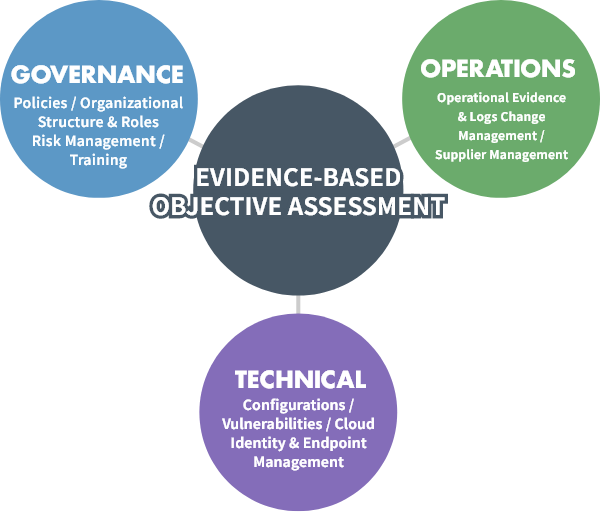
- Clarify Audit Criteria
- We translate SCS, NIST, and customer-specific criteria into practical audit items.
- Identify Missing Evidence
- We verify defensible evidence such as documents, tickets, logs, and configuration screens.
- Determine Criticality
- We prioritize findings based on risk, business impact, and remediation difficulty.
- Support Improvement
- Our support extends beyond the report to remediation planning and follow-up verification.
- Scope
- SCS Assessment Scheme ★3 and ★4, NIST SP 800-171, customer-specific checklists, NIST CSF, CIS, ISO, SOC 2, and more.
- Deliverables
- Audit report, gap register, evidence register, risk assessment, improvement roadmap, and presentation materials.
- Approach
- Criteria definition → evidence collection → document review → interviews/on-site verification → risk assessment → findings presentation.
- Service Positioning
- We provide audit preparation, mock audits, evidence development, and improvement support—not the official assessment performed by a designated assessment body under the applicable scheme.
Why Security Audits Are Essential Now
IPA's 10 Major Security Threats 2026 ranks ransomware, supply-chain and supplier risks, risks associated with AI use, and vulnerability exploitation among the leading issues that directly affect business continuity.
Priority Audit Themes Based on IPA's 10 Major Security Threats 2026 for Organizations
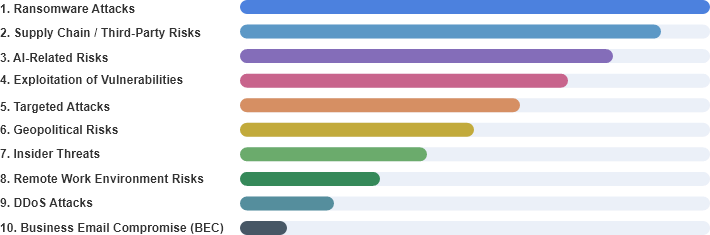
Source: Prepared based on IPA's “10 Major Security Threats 2026.” The audit perspective emphasizes ransomware, supply-chain risks, risks associated with AI use, and vulnerability management.
- Priority Audit Areas
- We assess ransomware defenses, supplier management, vulnerability management, log monitoring, incident response, and governance of AI use in connection with policies, roles, operational evidence, and continual improvement—not as isolated technical controls.
Challenges Addressed by Security Audits
Traditional audits that merely involve completing a checklist often fail to provide an accurate view of actual practices, clear improvement priorities, or persuasive explanations for customers.
Common Challenges and Our Audit-Based Solutions
Challenges
- Scattered Evidence
- Policies, tickets, and logs are siloed across departments
- Overlapping Customer Requirements
- Teams are overwhelmed by different checklists from each customer
- Subjective Self-Assessments
- It is difficult to substantiate claims that controls are working
- Unclear Cloud Configurations
- The actual state of identities, permissions, logs, and backups is unclear
- Weak Supplier Management
- Insufficient oversight of subcontracting, SLAs, and incident notification
- Stalled Remediation Plans
- Post-audit improvements stop when left to individual personnel
Audit Approach
- 1Criteria Integration
- Consolidate SCS, NIST, and proprietary criteria into a unified checklist
- 2Evidence Register
- List evidence available for submission and clearly identify gaps
- 3Risk Assessment
- Determine criticality based on likelihood, impact, and business consequences
- 4Improvement Roadmap
- Translate findings into 90-day and 180-day improvement plans
An audit is not simply an exercise in identifying deficiencies. It develops defensible information that supports ongoing business relationships, certification maintenance, and management decisions.
- Security education and training are ad hoc, making their effectiveness difficult to demonstrate.
- Audit records are maintained only as a formality for ISO 27001 or PrivacyMark certification and do not adequately address supply-chain requirements.
- Without an information security management function or CISO support, responses to customer requests depend on individual personnel.
- Security levels across the company, group companies, and suppliers cannot be compared and managed using common criteria.
Service Overview
We translate the SCS Assessment Scheme, NIST SP 800-171, and customer-specific criteria into audit items and evidence registers that can be verified in actual operations.
Service Portfolio
We combine scheme readiness, compliance reviews, customer audits, and technical verification according to the scope you require.
- 1SCS ★3 Expert Review Support
- Preparation for self-assessment, evidence registers, management declarations, and expert review.
- 2SCS ★4 Mock Audit and Technical Verification Readiness
- Gap analysis, evidence organization, and remediation support in preparation for third-party assessment and technical verification.
- 3NIST SP 800-171 Compliance Review
- Assessment of CUI scope, SSP, PoA&M, and control implementation using Examine, Interview, and Test methods.
- 4Custom Customer Framework Audit
- Mapping to requirements from NIST CSF, CIS Controls, ISO 27001, SOC 2, and other frameworks.
- Delivery Policy
- When a customer specifies a reporting format, we organize the audit results accordingly. If no format is specified, we use our standard checklist, evidence register, and improvement plan templates.
Audit Scope
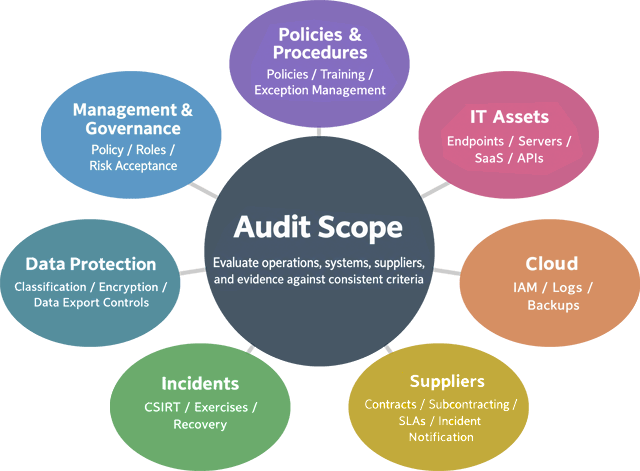
Our security audits cover not only IT systems, but also related assets, business processes, suppliers, and operational evidence.
Audit Scope Across the Organization, Operations, IT, and Suppliers
Security audits assess information assets, business processes, operational evidence, and supply-chain management as an integrated whole—not technology alone.
| Area | Key Review Items | Examples of Evidence |
|---|---|---|
| Organization and Governance | Accountability, division of roles, risk acceptance, management review | Organization charts, committee minutes, risk register |
| Policies and Procedures | Information classification, access management, supplier management, exception management | Policies, procedures, exception approval records |
| Technical Operations | Identity management, logging, vulnerabilities, backups, endpoint management | Configuration screens, logs, tickets, assessment results |
| Supplier Management | Contracts, SLAs, subcontracting, incident notification, periodic assessments | Contracts, questionnaires, assessment results, remediation records |
Supported Audit Criteria
Even when customers specify multiple standards, we reuse evidence across common control areas to reduce duplicated audit work.
Mapping to Major Frameworks
We map customer checklists to common control areas, identifying both coverage gaps and overlapping requirements.
| Control Area | SCS ★3/★4 | NIST SP 800-171 | NIST CSF 2.0 | CIS Controls v8.1 | ISO 27001 / SOC 2 |
|---|---|---|---|---|---|
| Governance | Management declarations and roles | PL / PM / RA | GOVERN | Control 17 | A.5 / CC1-2 |
| Asset and Data Management | Information assets and critical operations | AC / MP / CM | IDENTIFY | Control 1-3 | A.5 / CC6 |
| Access Control | Identities, permissions, and authentication | AC / IA | PROTECT | Control 5 6 | A.5 / CC6 |
| Logging and Monitoring | Log retention and detection | AU / SI | DETECT | Control 8 | A.8 / CC7 |
| Vulnerability and Configuration Management | Patches and configurations | CM / RA / SI | PROTECT | Control 4 / 7 | A.8 / CC7 |
| Supplier Management | Supply chain | SR / SA | GOVERN / ID | Control 15 | A.5 / CC9 |
| Incident Response and Recovery | Response, communications, and BCP | IR / CP | RESPOND / RECOVER | Control 11 / 17 | A.5 / CC7 |
- Key Point
- Evidence can be reused even when the standards differ.
Examples: access review records, retained logs, supplier assessments, and incident exercise records.
- NIST CSF 2.0: A comprehensive view of governance, operations, and technology based on Govern / Identify / Protect / Detect / Respond / Recover.
- CIS Controls v8.1: Practical cyberattack defenses assessed against high-priority implementation safeguards.
- ISO 27001 / SOC 2 / CSA CCM / ISMAP / industry-specific checklists: Audit items customized to customer requirements.
SCS Assessment Scheme ★3 and ★4 Audit Support
As of July 2026, IPA is continuing to publish and refine the details of the scheme. Based on publicly available information, we provide readiness assistance, evidence development, mock audits, and improvement support.
Support for SCS Assessment Scheme ★3 and ★4
According to information published by IPA, ★3 is expected to involve a self-assessment reviewed by an expert, while ★4 is expected to involve third-party assessment and technical verification. We help prepare audit-ready evidence and conduct mock audits for the application and assessment process.
★3 Expert-Reviewed Self-Assessment
- 1Complete
Self-Assessment - 2Evidence Register
and Expert
Review - 3Management
Declaration - 4Submit to Secretariat
and Register
★4 Third-Party Assessment and Technical Verification
- 1Complete
Self-Assessment - 2Engage an
Assessment Body - 3Third-Party Assessment
and Technical Verification - 4Report and
Registration Application
- Our Support
- Requirements interpretation / gap analysis / evidence register / mock audit / technical verification readiness / remediation plan / findings presentation
| Level | Published Assessment Scheme | Our Support |
|---|---|---|
| ★3 | A self-assessment reviewed by a security expert and submitted to the secretariat together with a management declaration of conformity. | Requirements interpretation, self-assessment review, evidence register development, management briefing, and pre-submission review. |
| ★4 | Third-party assessment and technical verification by an assessment body, followed by a registration application to the secretariat using the assessment report. | Mock audit, technical verification readiness, evidence review, improvement planning, and preparation of Q&A for the assessment body. |
NIST SP 800-171 Compliance Review
Based on contractual and customer requirements, we assess against Rev. 2 or Rev. 3 and review the CUI scope, SSP, PoA&M, and control implementation status.
NIST SP 800-171 Compliance Review
For systems and organizations that handle CUI, we verify implementation through documentation, interviews, and testing based on the principles of NIST SP 800-171 and 800-171A.
- 1Define CUI Scope
- Identify the information, systems, and suppliers in scope
- 2Review SSP
- Review the System Security Plan
- 3Assess Controls
- Verify implementation across all 17 control families
- 4Verify Evidence
- Cross-check documents, logs, screens, and tickets
- 5PoA&M
- Develop an improvement plan for outstanding items
Assessment Methods: Examine / Interview / Test
- Examine
- Review documents, configurations, logs, contracts, tickets, and other evidence
- Interview
- Interview management, the CISO, IT personnel, and business personnel about actual operations
- Test
- Validate samples, access rights, logs, backups, and configuration values in practice
- Review
Approach - NIST SP 800-171A defines assessment procedures and methodologies that can be tailored to the required depth and scope. Our service applies the Examine, Interview, and Test methods to verify that implementation status is consistent with the supporting evidence.
Customer Framework Audits
Based on the cybersecurity framework adopted by your customer, we design audit items, evidence requirements, assessment criteria, and response language.
Custom Audits Based on Customer Frameworks
Even when a customer uses a proprietary checklist, international standard, or cloud assessment framework, we translate its requirements into audit items and perform the review.
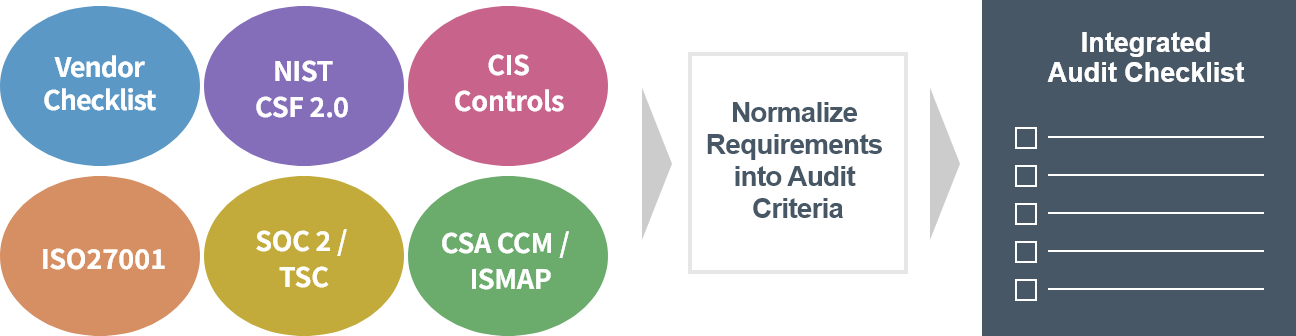
- Reduce Duplication
- Use the same evidence across multiple standards
- Clarify Gaps
- Distinguish unaddressed, partially addressed, and insufficiently evidenced items
- Improve Response Quality
- Prepare defensible evidence for customer explanations
- Continual Improvement
- Maintain a register for annual updates and reassessments
- For Customers
- Design supplier assessment checklists, review responses, audit critical suppliers, and assign risk ratings.
- For Suppliers
- Support responses to customer requirements, prepare evidence packages and improvement plans, and conduct pre-audit rehearsals.
- For Group Companies
- Conduct common audits across domestic and overseas locations, identify location-specific gaps, compare maturity, and design improvement KPIs.
- For Cloud/SaaS Providers
- Verify cloud-specific shared responsibilities and evidence using CSA CCM, SOC 2, ISMAP, ISO 27017, and other frameworks as references.
Audit Methodology and Assessment Criteria
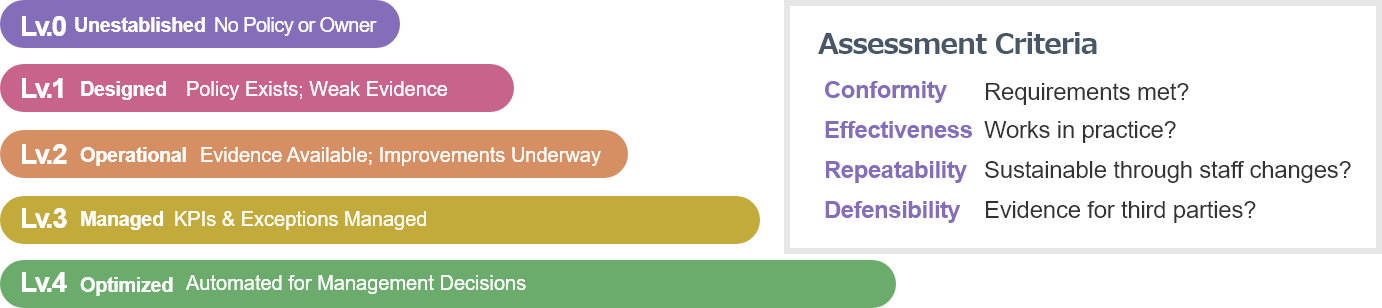
Our audits verify not only whether documentation exists, but also whether controls are operating, supported by evidence, and continually improved.
Audit Methodology: Evidence-Based Maturity Assessment
Through sampling and evidence reconciliation, we verify not only documented arrangements but also whether they are operating effectively in practice.
| Rating | Meaning | Example |
|---|---|---|
| Conforming | The requirement is met and supporting evidence is available. | Access rights are reviewed periodically and approval records are retained. |
| Partially Conforming | A process exists, but its scope, evidence, or frequency is insufficient. | Logs are retained only for some systems, or SaaS is excluded from inventories. |
| Nonconforming | Processes or evidence required by the requirement are missing. | No supplier assessment records exist, or access rights have not been reviewed. |
| Observation | Not an immediate nonconformity, but improvement is recommended. | Policy terminology is outdated, or exception management depends on specific individuals. |
Process from Initiation to Reporting
By clarifying the audit objective and intended recipients and organizing the required evidence and responsible personnel in advance, we deliver an effective audit within a short timeframe.
Service Process
We tailor the engagement to your objectives and scope, from a streamlined assessment completed in as little as 2–4 weeks to a comprehensive audit lasting 8–12 weeks.
- 1Kickoff
- Agree on objectives, criteria, scope, and project structure
- 2Requirements Definition
- Convert SCS, NIST, and customer requirements into audit items
- 3Evidence Collection
- Collect policies, logs, configurations, contracts, and tickets
- 4Interviews and Verification
- Verify actual operations and selected samples
- 5Gap Assessment
- Determine criticality, risk, and remediation difficulty
- 6Findings and Improvement Plan
- Present the report, evidence register, and roadmap
We define the evidence and responsible personnel for each phase, reducing dependence on individual staff and preventing duplicated audit work.
- Typical Duration
- Approximately 2–4 weeks for a light assessment, 4–6 weeks for SCS ★3 support, 6–10 weeks for a NIST SP 800-171 review, and 8–12 weeks for SCS ★4 or a comprehensive customer audit.
Deliverables
We deliver audit results in reusable formats suitable for customer submissions, management reporting, future audits, and continual improvement.
A Defensible Package for Customers, Management, and Assessors
Rather than providing a simple list of findings, we deliver a practical package that links evidence, risks, and improvement plans.
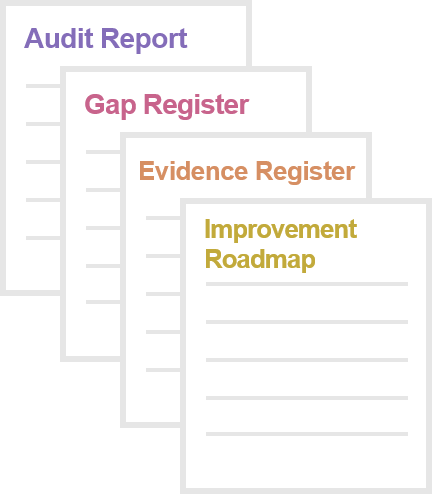
- Executive Summary
- Summary of critical risks, business impacts, and response priorities for management
- Audit Checklist
- Consolidated list of requirements, ratings, rationale, responsible personnel, and remediation deadlines
- Evidence Register
- Management of evidence available for submission and missing evidence
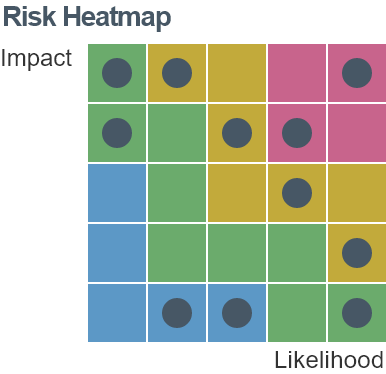
- Risk Heatmap
- Visualization of severity, likelihood, and residual risk
- Improvement Roadmap
- Action plan covering immediate, 60-day, 90-day, and post-180-day measures
- Presentation Materials
- Slide-based summary for presentations to customers and management
- Audit report: Overall assessment, critical risks, ratings, rationale, and management summary.
- Audit checklist: Requirements, ratings, comments, evidence links, owners, and deadlines.
- Evidence register: Available evidence, missing evidence, update frequency, and responsible owners.
- Improvement roadmap: Priorities, implementation sequence, required resources, and completion criteria.
Visualizing Audit Results
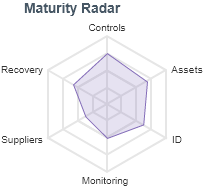
We provide both quantitative and qualitative visualizations so management, IT, and business departments can share a common understanding and work together on improvements.
Example Assessment Visualizations
Findings are visualized not merely as counts, but in terms of risk, evidence gaps, improvement priorities, and maturity by area.
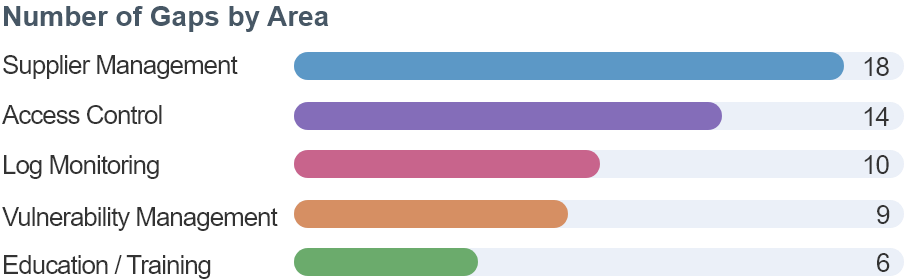
For each finding, the report links the requirement, current state, rationale, risk, recommended action, responsible owner, and deadline.
- For Management
- A 1–2 page summary of critical risks, business impacts, and information needed for budget and staffing decisions.
- For Operational Teams
- A traceable list covering requirements, evidence, remediation deadlines, and responsible personnel.
- For Customers
- Submission-ready response language, supporting documentation, and explanations of planned improvements.
- For Future Audits
- An evidence register and improvement history that reduce preparation effort for the next audit.
Post-Audit Follow-Up
We ensure that identified gaps are not left unresolved by organizing improvements into short-term remediation, medium-term development, and continual improvement initiatives.
Example Post-Audit Improvement Roadmap
Based on the audit results, we distinguish items requiring immediate remediation from those that should be systematized over the medium to long term.
-
- Days 0–30Immediate Remediation of Critical Risks
-
- MFA and access review
- Backup verification
- Strengthen customer responses
-
- Days 31–60Develop Operational Evidence
-
- Log retention procedures
- Supplier register
- Training records
-
- Days 61–90Scheme and Audit Readiness
-
- SCS/NIST evidence register
- Management review
- Mock audit
-
- After Day 90Continual Improvement and Automation
-
- Regular KPI reviews
- Monitoring and vulnerability management
- Reassessment
The improvement plan defines who is responsible, the deadline, and the evidence required to demonstrate completion, which we verify through a follow-up audit.
- Address critical risks immediately: MFA, public exposure settings, backups, vulnerabilities, privileged identities, log retention, and more.
- Maintain scheme-ready evidence: Keep submission-ready support for SCS, NIST, and customer requirements in an evidence register.
- Verify implementation through reassessment: Confirm evidence of completed remediation and organize residual risks and next-phase actions.
Additional Options
Depending on the issues identified during the audit, we can combine technical verification, education, training, policy revisions, SOC 2 readiness, and other services.
Optional Services
Based on the audit results, you can add the technical verification, education, training, and policy development services you require.
- Vulnerability Assessment
- Technical verification of web, network, and cloud configurations
- Cloud Configuration Review
- IAM, logging, encryption, backups, and public exposure settings
- Supplier Audit
- Supplier questionnaires, evidence reviews, and risk ratings
- Education and Training
- Role-based education, phishing simulations, and administrator training
- Incident Exercise
- Tabletop exercises covering initial response, reporting, customer communications, and recovery decisions
- SOC 2 Readiness
- Preparation for the Trust Services Criteria and evidence development
- Policy Revision
- Information security policy, supplier management, and exception management
- Dashboard Development
- Ongoing management of remediation status, evidence updates, and KPIs
Add only the services you need, keeping the engagement focused directly on your audit objectives without unnecessary consulting.
- Positioning Regarding SOC Reports
- This service does not issue SOC 2 or other assurance reports. It provides readiness assessments, evidence development, and control design reviews for SOC 2, ISAE 3000, and supplier control assessments.
Pricing Plans
We provide an individual quote based on the audit objectives, scope, number of systems, volume of evidence, and whether on-site work is required.
Sample Pricing Plans
Pricing depends on the scope, number of locations and systems, volume of evidence, and whether on-site work is required. The following figures are estimates.
-
Light Assessment
- Estimated Price
- From ¥300,000
- Duration
- 2–4 weeks
Review of key documents, brief interviews, and identification of critical gaps
-
SCS ★3 Support
- Estimated Price
- From ¥500,000
- Duration
- 4–6 weeks
Self-assessment, evidence register, expert review, and pre-submission review
-
NIST Review
- Estimated Price
- From ¥900,000
- Duration
- 6–10 weeks
CUI scope, SSP/PoA&M, control review, and findings presentation
-
SCS ★4 / Customer Audit
- Estimated Price
- From ¥1,200,000
- Duration
- 8–12 weeks
Mock audit, technical verification readiness, assessment body support, and improvement planning
* A formal quote will be provided following a free consultation.
* Prices exclude tax. Vulnerability assessments, on-site audits, overseas locations, English-language reports, official assessments as an assessment body, and other additional services are quoted separately.
| Pricing Factor | Considerations |
|---|---|
| Scope | Number of locations, departments, systems, cloud/SaaS services, and suppliers. |
| Audit Criteria | SCS, NIST SP 800-171, NIST CSF, CIS Controls, ISO/SOC 2, and customer-specific formats. |
| Volume of Evidence | Organization and availability of existing documents, logs, configuration screens, tickets, and contracts. |
| Verification Method | Remote or on-site work, technical verification, English-language support, and number of findings presentations. |
Frequently Asked Questions
During the initial consultation, we confirm the audit objective, intended recipient, criteria, deadline, and scope, then recommend the most efficient approach.
- We received a proprietary checklist from a customer. Can you support us?
- Yes. We classify the requirements by control area and distinguish items that can be answered using existing evidence from those requiring additional action.
- Can you help us obtain SCS Assessment Scheme ★4?
- Official third-party assessments and technical verification are expected to be performed by designated assessment bodies and technical verification providers under the scheme. We provide pre-assessment mock audits, evidence development, remediation support, and preparation for working with the assessment body.
- Do you assess NIST SP 800-171 against Rev. 2 or Rev. 3?
- We follow the applicable contract terms and customer requirements. We can support continued compliance with Rev. 2 or conduct a proactive gap assessment against Rev. 3.
- Can a vulnerability assessment be included in the audit?
- Yes, it can be added as an optional service. During the audit, we also verify whether the assessment results are reflected in the risk assessment, remediation plan, and supporting evidence.
- Can the audit report be submitted to our customer?
- Yes. We can prepare separate customer-facing and detailed internal versions based on the recipient's format and the applicable confidentiality boundaries.
References and Contact Information
This service information has been prepared based on publicly available information as of July 8, 2026.
References
| Category | Document | URL |
|---|---|---|
| SCS Assessment Scheme | IPA: “Security Measures Assessment Scheme for Strengthening Supply Chains (SCS Assessment Scheme)” | https://www.ipa.go.jp/security/scs/index.html |
| SCS Assessment Scheme | IPA: “Detailed Information on the SCS Assessment Scheme” | https://www.ipa.go.jp/security/scs/details.html |
| Threat Intelligence | IPA: “10 Major Security Threats 2026” | https://www.ipa.go.jp/security/10threats/10threats2026.html |
| NIST | NIST SP 800-171 Rev.3 | https://csrc.nist.gov/pubs/sp/800/171/r3/final |
| NIST | NIST SP 800-171A Rev.3 | https://csrc.nist.gov/pubs/sp/800/171/a/r3/final |
| NIST | The NIST Cybersecurity Framework 2.0 | https://www.nist.gov/cyberframework |
| CIS | CIS Critical Security Controls Version 8.1 | https://www.cisecurity.org/controls/v8-1 |
| Management Guidelines | Ministry of Economy, Trade and Industry: “Cybersecurity Management Guidelines Ver. 3.0” | https://www.meti.go.jp/policy/netsecurity/mng_guide.html |
Contact our security professionals today for an initial consultation.
