

Overview
What is the NIST CSF?
The NIST Cybersecurity Framework (CSF) helps organizations understand, assess, prioritize, and communicate cybersecurity risk. It provides a common set of outcomes that can be adapted to an organization’s size, sector, risk profile, and business requirements.
What is NIST CSF 2.0?
Published on February 26, 2024, NIST CSF 2.0 expands the framework’s focus beyond critical infrastructure to organizations of all sizes and sectors. It adds Govern to the five existing Functions: Identify, Protect, Detect, Respond, and Recover.

Figure 1. Differences Between NIST CSF 2.0 and the Previous Cybersecurity Framework
CSF 2.0 places greater emphasis on governance and cybersecurity supply chain risk management. Its outcomes and supporting resources help organizations connect cybersecurity activities with business objectives and risk decisions.
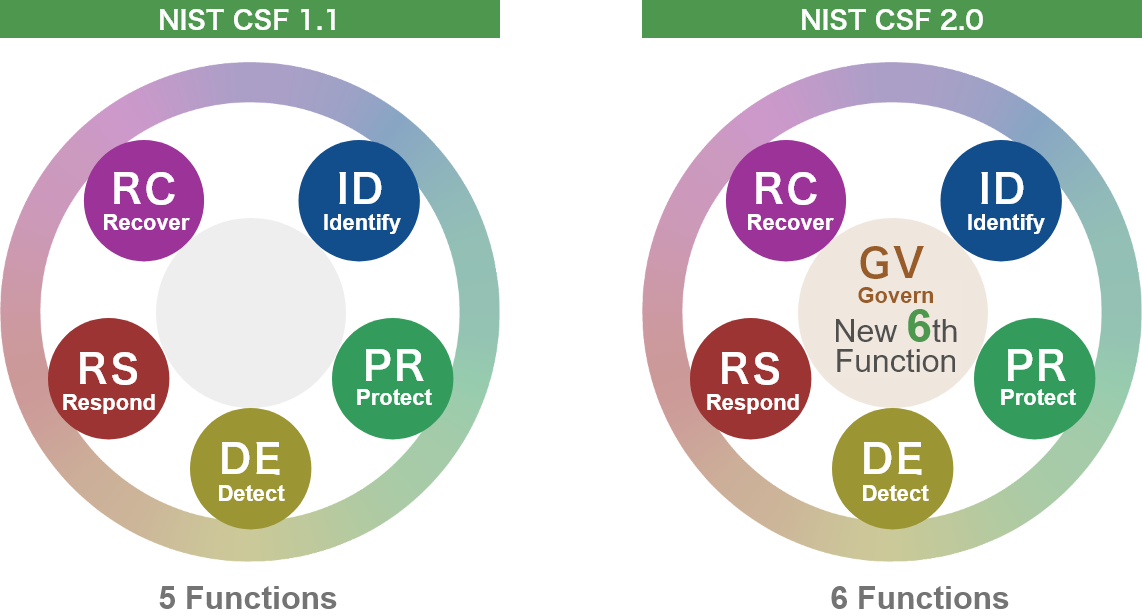
Figure 2. Differences Between NIST CSF 1.1 and 2.0
NIST CSF Structure
The NIST CSF consists of three elements: the Core, Tiers, and Profiles. Using these three elements makes it easier for companies and organizations to analyze gaps between their current and target cybersecurity postures.
NIST CSF Components
| No | Component | Definition |
|---|---|---|
| 1 | Core | A set of cybersecurity outcomes organized into defined categories |
| 2 | Tiers | Four Tiers that characterize the rigor of cybersecurity risk governance and management practices |
| 3 | Profiles | An organization's current (As-Is) and target (To-Be) cybersecurity postures |
The CSF 2.0 Core organizes cybersecurity outcomes into six Functions, 22 Categories, and 106 Subcategories. The new Govern Function connects cybersecurity with organizational context, risk strategy, responsibilities, policy, oversight, and supply chain risk management.
Differences Between the NIST CSF 1.1 and NIST CSF 2.0 Core Functions
| Function | Category | Subcategories | |
|---|---|---|---|
| Identify (ID) |
ID.AM | Asset Management | 6 |
| ID.BE | Business Environment | 5 | |
| ID.GV | Governance | 4 | |
| ID.RA | Risk Assessment | 6 | |
| ID.RM | Risk Management Strategy | 3 | |
| ID.SC | Supply Chain Risk Management | 5 | |
| Protect (PR) |
PR.AC | Identity Management, Authentication and Access Control | 7 |
| PR.AT | Awareness and Training | 5 | |
| PR.DS | Data Security | 8 | |
| PR.IP | Information Protection Processes and Procedures | 12 | |
| PR.MA | Maintenance | 2 | |
| PR.PT | Protective Technology | 5 | |
| Detect (DE) |
DE.AE | Anomalies and Events | 5 |
| DE.CM | Security Continuous Monitoring | 8 | |
| DE.DP | Detection Processes | 5 | |
| Respond (RS) |
RS.RP | Response Planning | 1 |
| RS.CO | Communications | 5 | |
| RS.AN | Analysis | 5 | |
| RS.MI | Mitigation | 3 | |
| RS.IM | Improvements | 2 | |
| Recover (RC) |
RC.RP | Recovery Planning | 1 |
| RC.IM | Improvements | 2 | |
| RC.CO | Communications | 3 | |
| Function | Category | Subcategories | |
|---|---|---|---|
| Govern (GV) |
GV.OC | Organizational Context | 5 |
| GV.RM | Risk Management Strategy | 7 | |
| GV.RR | Roles, Responsibilities, and Authorities | 4 | |
| GV.PO | Policy | 2 | |
| GV.OV | Oversight | 3 | |
| GV.SC | Cybersecurity Supply Chain Risk Management | 10 | |
| Identify (ID) |
ID.AM | Asset Management | 7 |
| ID.RA | Risk Assessment | 10 | |
| ID.IM | Improvement | 4 | |
| Protect (PR) |
PR.AA | Identity Management, Authentication, and Access Control | 6 |
| PR.AT | Awareness and Training | 2 | |
| PR.DS | Data Security | 4 | |
| PR.PS | Platform Security | 6 | |
| PR.IR | Technology Infrastructure Resilience | 4 | |
| Detect (DE) |
DE.CM | Continuous Monitoring | 5 |
| DE.AE | Adverse Event Analysis | 6 | |
| Respond (RS) |
RS.MA | Incident Management | 5 |
| RS.AN | Incident Analysis | 4 | |
| RS.CO | Incident Response Reporting and Communication | 2 | |
| RS.MI | Incident Mitigation | 2 | |
| Recover (RC) |
RC.RP | Incident Recovery Plan Execution | 6 |
| RC.CO | Incident Recovery Communication | 2 | |
History of the NIST CSF
Security threats are becoming increasingly diverse and complex due to factors such as the rapid rise in serious cyberattacks worldwide and the risks accompanying widespread adoption of new technologies such as generative AI. In response, countries have introduced cybersecurity laws, regulations, directives, and guidelines. Internationally recognized cybersecurity frameworks and guidelines include the NIST CSF, CIS Controls, and the ISO/IEC 27000 series. In particular, the NIST CSF provides comprehensive outcomes that address cyber resilience. Its broad applicability has led to growing adoption by public- and private-sector organizations around the world.
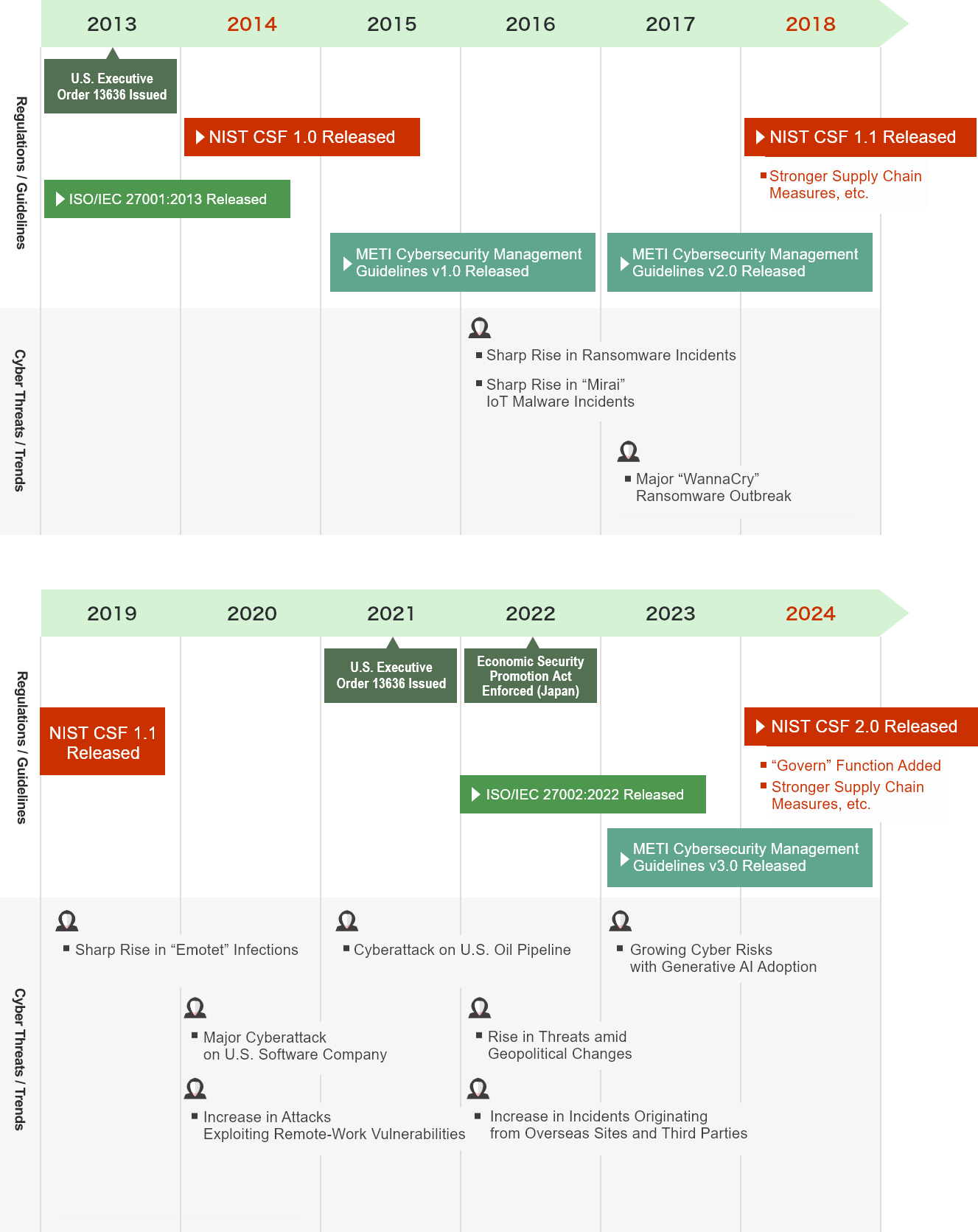
Timeline Leading to the Release of NIST CSF 2.0
- 2013
- National and economic security depended on the reliable operation of critical infrastructure, while cyberattacks were becoming more sophisticated and causing increasing damage each year.
U.S. President Barack Obama issued an Executive Order to strengthen critical infrastructure cybersecurity capabilities.
- 2014
- In response to the Executive Order, NIST gathered data and input from more than 3,000 participants, including experts, government agencies, and critical infrastructure organizations, and published CSF 1.0.
NIST's work was highly regarded, and the CSF became a widely supported framework among private-sector organizations and government agencies.
- 2018
- The framework was revised as CSF 1.1, with controls relating to supply chain risk management receiving particular attention.
CSF 1.1 was used not only in the United States but by a wide range of organizations worldwide to assess and improve their cybersecurity posture.
- 2024
- CSF 2.0 was officially released in February 2024, marking the first major revision in approximately ten years.
The framework was revised for organizations of all industries and sizes, further expanding its potential use as organizational guidance.
Infosec Advisory's NIST Cybersecurity Framework Consulting Services

Infosec Advisory provides NIST CSF consulting from business risk assessment through operational improvement. We assess your current practices, define a target state, and develop a prioritized implementation roadmap. Our team also draws on ISO 27001 consulting experience to help align the framework with your existing management system.
NIST CSF 2.0 Implementation Process
- 1. Understand the Revisions
- We begin by identifying the changes made in NIST CSF 2.0 compared with NIST CSF 1.1.
- 2. Assess Alignment with NIST CSF 2.0
- After reviewing the revisions, we use assessment sheets and other tools to evaluate whether your current policies align with NIST CSF 2.0.
- 3. Understand Actual Operations
- We conduct interviews and other reviews to understand how policies are implemented in day-to-day operations.
- 4. Prepare Policies and Procedures
- Based on the alignment assessment and operational interview results, we prepare the necessary policies and procedures.
- 5. Conduct a Follow-Up Assessment
- We conduct a follow-up assessment to confirm that the policies and procedures are operating effectively.
Our NIST CSF Approach
- 1. Identify Critical Information Assets
-
- Inventory and identify critical information assets within scope
- Review the lifecycle of critical information assets
- Create a register of critical assets
- 2. Conduct a Risk Assessment
-
- Apply the NIST CSF checklist
- Assess and analyze business impact and risk
- Document risk assessment criteria
- 3. Conduct NIST CSF-Aligned Internal Audits
-
- Conduct security self-assessments across all departments
- Provide internal auditor training
- Conduct internal audits
- 4. Develop and Implement a Corrective Action Plan
-
- Prepare a corrective action plan
- Implement corrective actions
- 5. Monitor Progress
-
- Review the status of security operations
What is a SOC Report?
SOC stands for System and Organization Controls. SOC reports communicate the results of an independent examination of a service organization’s controls. Their scope and intended use depend on the type of report.
For SOC 2, a qualified independent CPA firm examines the service organization’s controls against the relevant Trust Services Criteria and issues the report.
Infosec Advisory provides readiness, control design, evidence management, and audit coordination support. The independent examination and assurance opinion are the responsibility of the engaged CPA firm.
We provide services tailored to your requirements. Please call us to discuss how we can help.
