

End-to-End SOC 2 Type 2 Support - from Readiness through Audit Completion
We provide end-to-end support for SaaS, cloud service, and BPO providers preparing for a SOC 2 Type 2 examination, including scope definition, control design, evidence operations, and audit coordination. Type 2 requires more than a one-time setup: controls must operate consistently throughout a defined period. We help establish practical, sustainable operations that can withstand independent examination.
Are You Facing Any of These SOC 2 Type 2 Challenges?
- Overseas customers or large enterprises require you to provide a SOC 2 Type 2 report.
- You have completed Type 1 but are unsure what evidence to retain during the Type 2 examination period.
- Evidence for access management, change management, and vendor management is scattered across departments.
- It takes too long to determine which evidence should be provided in response to auditor requests.
- You have implemented a GRC tool, but control design and evidence collection processes are not yet embedded.
- You have an ISMS and internal policies but cannot clearly explain them against the SOC 2 criteria.
SOC 2 Type 2 cannot be completed simply by assembling documents. You must define the service scope, customer commitments, cloud environment, development processes, vendor management, and incident response arrangements, then demonstrate through evidence that the controls operated throughout the examination period. We turn these requirements into workable processes, from current-state review through operational adoption, reducing the burden of audit preparation and coordination.
SOC 2 Type 2 Support That Accelerates Sales, Security Reviews, and Audits
- Understand Your Current State Quickly
- We review your existing ISMS, cloud configurations, development and operational records, and vendor management practices to identify gaps for SOC 2 Type 2.
- Manage Evidence Continuously
- We review key operational records each month, including access reviews, change management, vulnerability management, and incident response evidence.
- Streamline Audit Coordination
- We manage auditor requests, follow-up questions, and evidence submissions while minimizing the workload on internal teams.
What is SOC 2 Type 2?
A SOC 2 Type 2 report evaluates whether a service organization's controls operated effectively over a defined period.
SOC 2 addresses controls at organizations that handle customer data or business processes, including cloud, SaaS, data processing, and BPO providers. The scope is selected from the Trust Services Criteria for Security, Availability, Processing Integrity, Confidentiality, and Privacy, based on the service and customer requirements.
Type 2 evaluates not only whether controls are suitably designed, but also whether they operate consistently throughout the specified period. It is therefore essential to retain ongoing evidence such as access reviews, change approvals, incident records, vendor reviews, and vulnerability remediation records.
-
- Security
- Protect systems and data against unauthorized access, disclosure, and vulnerabilities.
-
- Availability
- Maintain agreed service availability and recovery commitments.
-
- Proscessing Intergrity
- Ensure processing is complete, valid, accurate, timely, and authorized.
-
- Confidentiality
- Manage the use, disclosure, retention, and disposal of confidential information.
-
- Privacy
- Manage the collection, use, retention, disclosure, and disposal of personal information.
SOC 2 Type 1 vs. Type 2
| Item | SOC 2 Type 1 | SOC 2 Type 2 |
|---|---|---|
| Assessment focus | Whether controls are suitably designed as of a specified date. | Whether controls are suitably designed and operate effectively over a specified period. |
| What is evaluated | Control design, scope, in-scope systems, control owners, and related matters. | Control design plus operating evidence, exceptions, remediation, and consistency. |
| Primary use | Initial assurance and short-term responses to customer requirements. | Enterprise and international customer due diligence and ongoing assurance. |
| Preparation focus | Define the controls and scope clearly. | Maintain evidence, conduct monthly reviews, and coordinate audit requests. |
Note: The independent opinion is issued by a qualified independent CPA or audit firm. Our role is to provide readiness, control design, evidence operations, and audit coordination support.
End-to-End Support for SOC 2 Type 2 Readiness, Operations, and Audit Coordination
Our SOC 2 Type 2 service covers the full journey: initial consultation, current-state assessment, scope definition, control design, evidence collection, audit coordination, and post-report improvement management. We coordinate activities across security, development, infrastructure, HR, legal, sales, customer success, and other functions, establishing processes your organization can sustain internally.
- 1. Readiness Assessment
- Review current operations, policies, cloud environments, and evidence to identify and prioritize gaps for SOC 2 Type 2.
- 2. Scope Definition
- Define the in-scope services, system boundaries, data flows, vendors, locations, cloud platforms, and Trust Services Categories.
- 3. Control Design
- Define controls for access management, change management, incident response, vulnerability management, vendor management, and related areas.
- 4. Evidence Design
- Specify the evidence type, frequency, owner, storage location, and review method for each control.
- 5. Operational Adoption
- Support monthly reviews, completeness checks, exception handling, and remediation tracking throughout the examination period.
- 6. Audit Support
- Organize audit requests, review evidence submissions, prepare responses to follow-up questions, and manage remediation items.
- 7. Renewal Planning
- Organize findings, improvement actions, and the operating calendar for the next examination period.
Detailed Support Services
Readiness Assessment / Gap Analysis
We review your security operations, cloud configurations, internal policies, access management, change management, vulnerability management, and vendor management. Before the Type 2 examination period begins, we identify gaps and develop a prioritized remediation schedule.
Scope and Trust Services Category Definition
We define the services, systems, subservice organizations, data types, and customer service commitments within the SOC 2 report scope. Starting with Security, we assess whether Availability, Confidentiality, Processing Integrity, and Privacy should also be included.
Control and Evidence Mapping
For each control, we map the owner, operating frequency, review method, and required evidence. We maintain a clear inventory of control IDs, evidence names, storage locations, and submission status to support efficient audit responses.
Monthly Reviews During the Examination Period
Type 2 requires evidence that controls operated consistently throughout the examination period. Each month, we review evidence availability and quality, exceptions, and remediation progress, reducing last-minute rework before the audit.
GRC Tool Enablement
When using GRC tools such as Drata, Vanta, or Secureframe, we configure control items, evidence integrations, owners, notifications, and auditor access. We also help organizations with existing tools establish effective and sustainable operating practices.
Audit Coordination Support
We organize auditor request lists, review submitted evidence, draft responses to follow-up questions, coordinate requests across departments, and track remediation tasks. This creates visibility into auditor communications and prevents missed actions.
Our Approach to SOC 2 Type 2
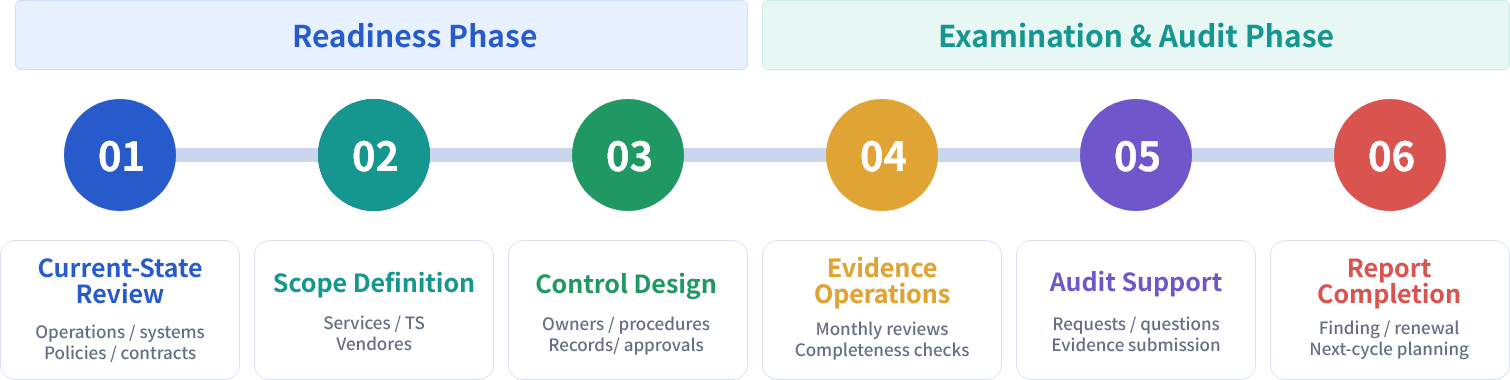
-
- 1 Initial Consultation
-
Confirm the target service, customer requirements, desired timeline, and current security operations.
-
- 2 Current-State Review
-
Review existing documentation, cloud environments, operating records, vendor management, and development workflows.
-
- 3 Scope Definition
-
Define the systems, data, vendors, Trust Services Categories, examination period, and potential auditors.
-
- 4 Control and Evidence Design
-
Document the controls and evidence required for Type 2, including owners and operating frequencies.
-
- 5 Examination-Period Operations
-
Review evidence monthly and manage omissions and exceptions as remediation tasks.
-
- 6 Audit Coordination
-
Manage audit requests, evidence submissions, follow-up questions, and remediation through audit completion.
-
- 7 Post-Report Improvement
-
Incorporate audit findings and operational lessons into the next annual reporting cycle.
Illustrative Timeline
- Preparation | 1–2 monthsCurrent-state review, scope definition, control and evidence mapping, and owner assignment.
- Examination period | 3–12 monthsMonthly evidence reviews, exception management, access reviews, change management, and vendor reviews.
- Audit | 1–2 monthsEvidence submission, responses to follow-up questions, remediation tracking, and report issuance support.
- Renewal planningOperational improvements, action tracking, and annual review for the next reporting cycle.
Note: Timelines vary depending on service scope, the maturity of existing security operations, selected Trust Services Categories, and the auditor's approach.
We tailor our services to your specific requirements. Contact us to take the first step toward building trust in global markets.
Support During the Type 2 Examination Period
Reliable Monthly Evidence Management Throughout the Examination Period
SOC 2 Type 2 requires evidence that controls operated continuously throughout the examination period. Collecting documents immediately before the audit may not be sufficient if monthly review records or approval histories are missing. We support monthly evidence checks, owner reminders, exception analysis, and remediation tracking to minimize audit rework.
Type 2 Examination-Period Operations Dashboard
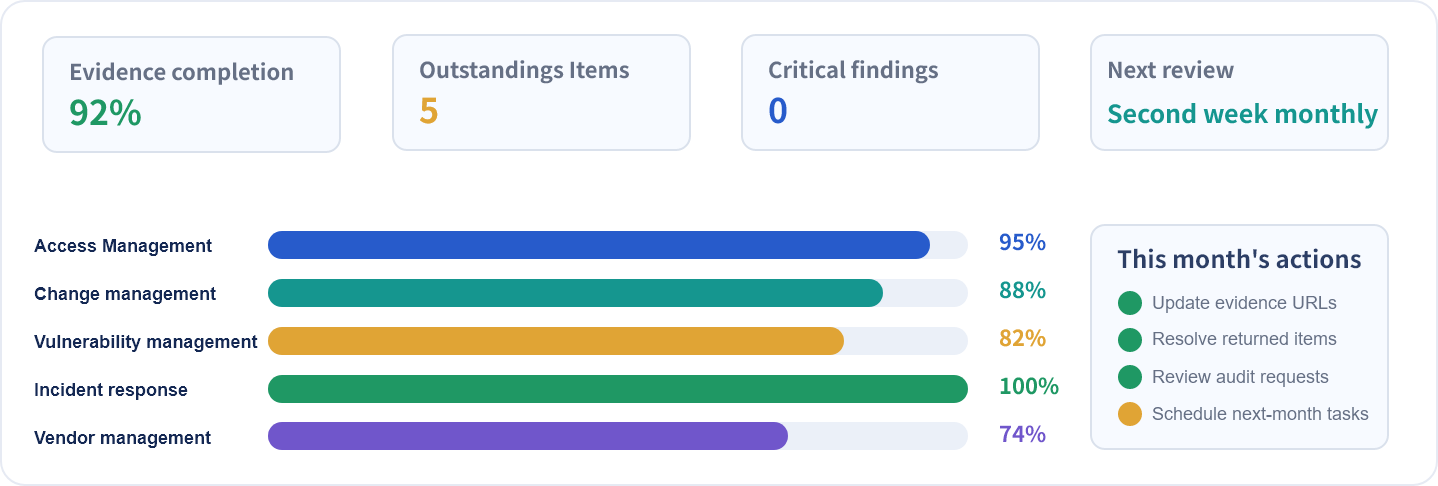
Key Areas Reviewed Each Month
- Access Management
- Joiners and leavers, access grants and revocations, privileged IDs, periodic reviews, MFA settings, and related controls.
- Change Management
- Code reviews, approvals, release records, emergency changes, rollback procedures, and related controls.
- Vulnerability Management
- Vulnerability assessments, scan results, remediation deadlines, retest results, exception approvals, and related records.
- Incident Response
- Incident records, response history, impact assessments, corrective actions, notification decisions, and related records.
- Vendor Management
- Critical-vendor assessments, contracts, security reviews, annual reviews, and related records.
- Backup and Availability
- Backup results, recovery tests, service availability, outage records, and related evidence.
- Employee Training
- Onboarding and annual training, completion records, and follow-up with overdue personnel.
Evidence Management
Saving files alone is not enough. The organization must be able to explain which control each item supports, the period it covers, who reviewed it, and how any exceptions were addressed. We organize evidence inventories, submission status, returned-item history, and remediation tasks so that evidence can be explained clearly to the auditor.
Evidence Collection and Audit Coordination Workflow
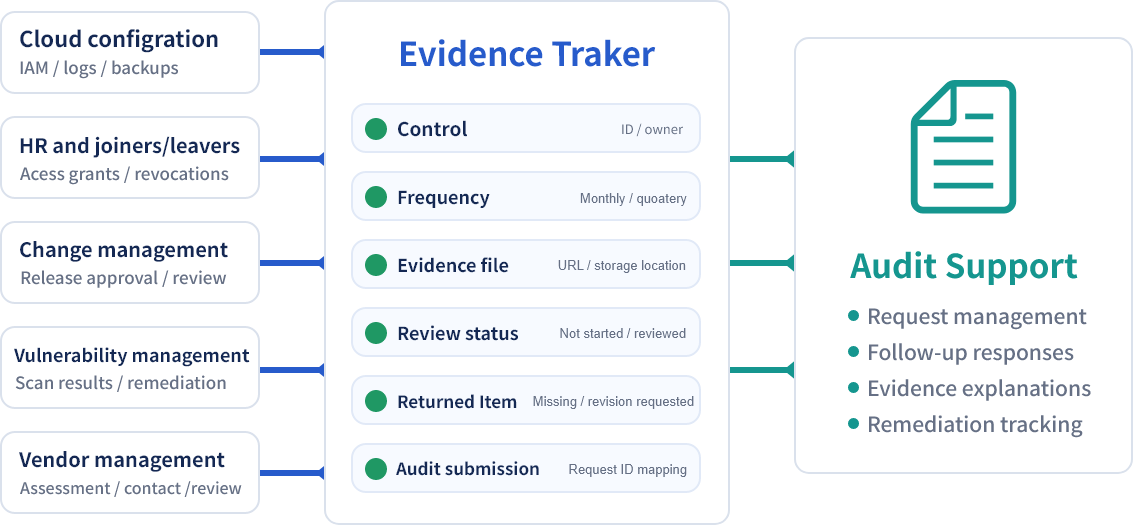
Deliverables
Organized Documentation and Operating Records for the Audit
For SOC 2 Type 2, information distributed across the organization must be organized in a form that can be clearly presented during the audit. We develop practical deliverables, including a readiness assessment report, control inventory, evidence tracker, remediation action list, and audit request tracker, and support their adoption in day-to-day operations.
- Readiness Assessment Report
- A report summarizing current gaps, priorities, and the remediation roadmap.
- Scope Documentation
- Documentation of in-scope services, system boundaries, data flows, vendors, and Trust Services Categories.
- Control Matrix
- An inventory of control IDs, objectives, owners, frequencies, required evidence, and related systems.
- Evidence Tracker
- A tracker for evidence names, submission cycles, storage locations, status, returned items, and reviewers.
- Remediation Action List
- A tracker for gaps, action owners, deadlines, priorities, completion criteria, and supporting evidence.
- Audit Request Tracker
- A tracker for auditor requests, responses, submitted materials, follow-up questions, and status.
- Monthly Operations Calendar
- An annual schedule for reviews, access recertifications, training, vendor reviews, and other control activities.
Note: Type 2 requires an examination period, so control operations should begin early enough to establish the required operating history.
Target Organizations and Use Cases
Recommended For
- 1B2B SaaS Companies
-
- Organizations asked to complete security reviews or provide a SOC 2 report when selling to large or overseas enterprises.
- 2Cloud Service Providers
-
- Providers that store or process customer data in the cloud and need independent assurance over service reliability.
- 3Fintech / HRTech / HealthTech
-
- Organizations handling sensitive data and facing stringent customer security requirements.
- 4Globally Expanding Companies
-
- Organizations considering SOC 2 Type 2 to demonstrate assurance to overseas customers, investors, and partners.
- 5ISMS-Certified Organizations
-
- Organizations seeking to leverage an existing ISMS while preparing for a SOC 2 Type 2 examination period.
Client Feedback
- Case 1Company A
-
- An overseas customer required us to provide a SOC 2 Type 2 report, and we did not know where to begin. The current-state assessment clarified our gaps, and the evidence management process allowed us to manage the examination period in a planned and controlled manner.
- Case 2Company B
-
- Every new auditor request used to stall while we checked internally. Once the request list and evidence tracker were established, we gained clear visibility into the status and owner of each response.
Plans and Pricing
A Support Plan Tailored to Your Maturity and Reporting Timeline
The support required for SOC 2 Type 2 depends on the size of the service scope, the maturity of existing security operations, the examination period, selected Trust Services Categories, the GRC tools used, and the auditor's approach. During the initial consultation, we assess your current situation and propose an appropriate scope and indicative timeline.
| Plan | Scope |
|---|---|
| Light | Readiness assessment, gap analysis, and prioritized recommendations. Designed for organizations that first need a clear view of their current position. |
| Standard | Scope definition, control and evidence mapping, monthly reviews during the examination period, and audit coordination. Designed for organizations pursuing their first Type 2 report. |
| Premium | Comprehensive support across multiple services, departments, and international customer requirements, including GRC tool enablement, vendor management, and renewal planning. |
Pricing is quoted individually based on the service scope, support period, evidence volume, meeting frequency, and level of audit coordination required. Contact us for an initial consultation to discuss your current position and desired timeline.
Frequently Asked Questions
- Is SOC 2 Type 2 a certification?
- Although SOC 2 is sometimes informally described as a certification, it is an attestation report issued by an independent auditor. For ease of understanding, we may use terms such as 'obtain' or 'achieve' when describing the process.
- Do we need to complete SOC 2 Type 1 first?
- No. An organization may proceed directly to Type 2. However, Type 1 may be useful when an immediate customer requirement must be addressed or when management wants an independent assessment of control design before the Type 2 examination period.
- What should we do during the examination period?
- Retain evidence continuously for the controls in scope, such as access reviews, change management, vulnerability remediation, incident response, vendor reviews, and training. We review the availability and quality of this evidence each month.
- Can you also perform the independent examination?
- The independent opinion must be issued by a qualified independent CPA or audit firm. We provide readiness, evidence management, and practical audit coordination support, and can help identify key considerations when selecting an auditor.
- We already have an ISMS. Do we still need to prepare for SOC 2 Type 2?
- Many elements of an existing ISMS can be leveraged. However, SOC 2 Type 2 requires the controls and operating evidence for the in-scope service to be explained against the Trust Services Criteria. We identify what can be reused and what additional work is required.
- Is a GRC tool required?
- No. A GRC tool is optional, but it can improve evidence management, owner notifications, cloud integrations, and auditor collaboration. If a tool is already in place, we help configure and operate it for SOC 2 Type 2.
- Can you support a small start-up?
- Yes. We tailor controls and evidence processes to the organization's size and risk profile rather than creating unnecessary complexity. The overall timeline depends on readiness, the examination period, and audit requirements; we will propose a practical schedule during the initial consultation.
- Can a SOC 2 report be published on a website?
- SOC 2 reports are generally restricted-use reports containing detailed control and testing information and are not normally published in full. Organizations may publicly state that a report has been issued, subject to applicable terms, or consider a SOC 3 report when public distribution is required.
- Can you support communications with customers in English?
- Yes. We can help prepare English-language customer materials, evidence narratives, and responses to security-review and auditor questions, and support coordination with overseas stakeholders.
- What should we prepare for the initial consultation?
- Please share whatever is currently available, such as an overview of the target service, current security operations, customer requirements, desired timing, and whether an auditor has been selected. We can begin even if the documentation is not yet complete.
We tailor our services to your specific requirements. Contact us to take the first step toward building trust in global markets.
