

Overview / Process
Service Overview
Cyber risks facing businesses have become increasingly diverse and sophisticated. As organizations improve operational efficiency and advance digital transformation (DX), the threat of cyberattacks continues to grow. Effective system security is essential in this environment. Nevertheless, many organizations continue to operate with vulnerabilities that could be exploited by external attackers, potentially leading to serious incidents such as major data breaches and system outages.
Infosec Advisory Co., Ltd. (Infosec Advisory) provides penetration testing services that use real-world attack techniques to evaluate system security. Our independent testing enables organizations to assess the security of their information assets and identify and remediate potential risks at an early stage.
What is Penetration Testing?
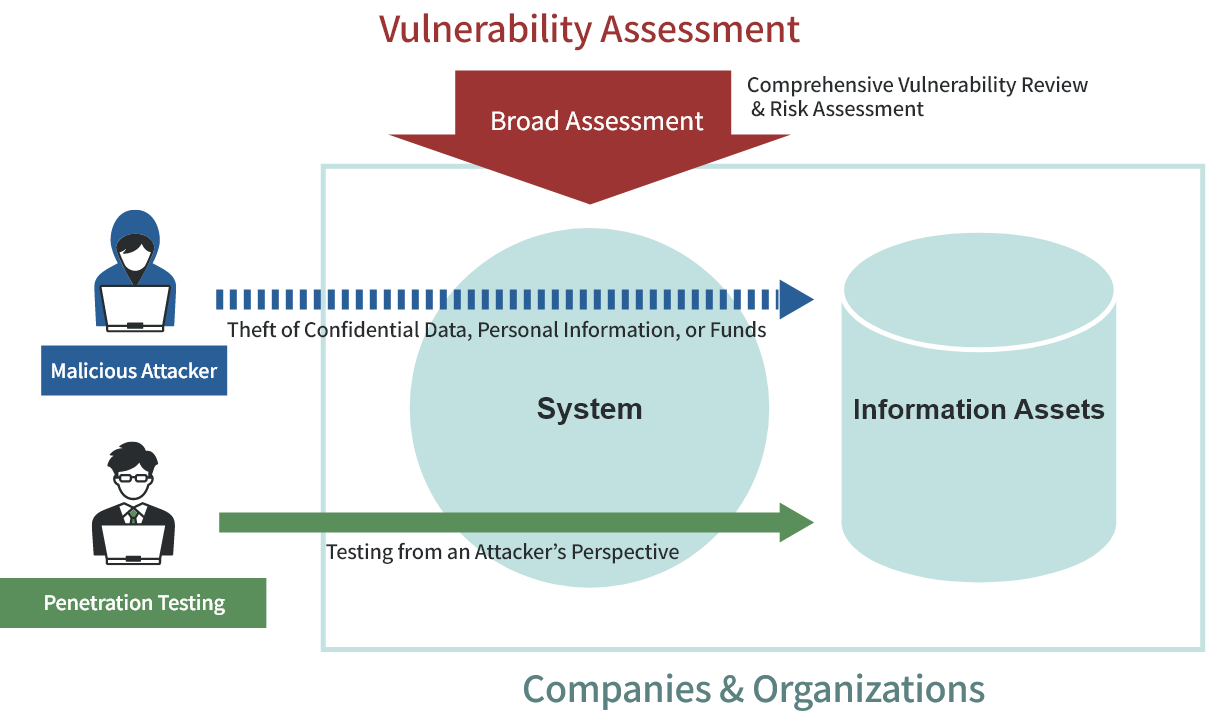
Penetration testing evaluates the effectiveness of security controls protecting IT infrastructure. While a vulnerability assessment broadly identifies system vulnerabilities, a penetration test evaluates defenses against specific attack scenarios targeting selected information assets, such as confidential or personal information.
Purpose of Penetration Testing
Unlike a vulnerability assessment, penetration testing attacks a system from an adversary's perspective using defined scenarios to determine the actual harm that could occur.
| Identifying Vulnerabilities | By simulating attacks against the system based on defined scenarios, we identify specific latent vulnerabilities and assess the feasibility of attacks against the system. |
|---|---|
| Prioritizing Security Risks | We evaluate the vulnerabilities and security risks identified during testing to determine which issues require priority remediation. |
| Verifying the Effectiveness of Security Controls | We assess how effectively existing security controls withstand attacks and recommend improvements and remediation priorities as needed. |
| Improving Employee Security Awareness | Understanding real-world intrusion risks raises employee security awareness and helps strengthen the organization's overall security posture. |
Who needs Penetration Testing?
Infosec Advisory recommends conducting penetration testing in the following situations.
- When regulators or business partners require periodic analysis and assessment.
- When new network infrastructure or applications are introduced.
- After significant upgrades or modifications to infrastructure or applications.
- When opening or relocating an office.
- When end-user policies change.
- After significant changes to your system or network configuration.
Benefits of Penetration Testing
Penetration testing conducted by Infosec Advisory provides the following benefits.
| Reduced Risk of Data Breaches | Drawing on our extensive penetration testing experience, independently researched incident cases, and threat intelligence, we identify potential attack paths in advance and minimize the risk of data leakage. |
|---|---|
| Stronger Regulatory Compliance | Implement security measures aligned with applicable national regulations and industry standards. |
| Employee Education | Combining testing with employee education, interviews, and advanced social-engineering exercises can reduce incident response costs and help prevent damage to corporate trust and reputation. |
| Stronger Defenses Against Cyberattacks | Testing systems through simulated attacks based on diverse scenarios helps establish a security posture capable of addressing the latest threats. |
Types of Penetration Testing We Provide
Infosec Advisory can perform a wide variety of penetration testing activities, including the following.
| Network Vulnerability Assessment | Assess intrusion paths and risks across external and internal networks. |
|---|---|
| Web Application Testing | Evaluate web application vulnerabilities, including SQL injection and cross-site scripting (XSS), using a variety of attack scenarios. |
| Mobile Application Testing | Examine security risks in mobile applications and evaluate application-specific threats. |
| Client-Side Testing | Assess the security of desktop applications and endpoint environments. |
| Cloud Security Assessment | Assess cloud service security configurations and access controls to verify that appropriate settings are in place. |
Penetration Testing Process
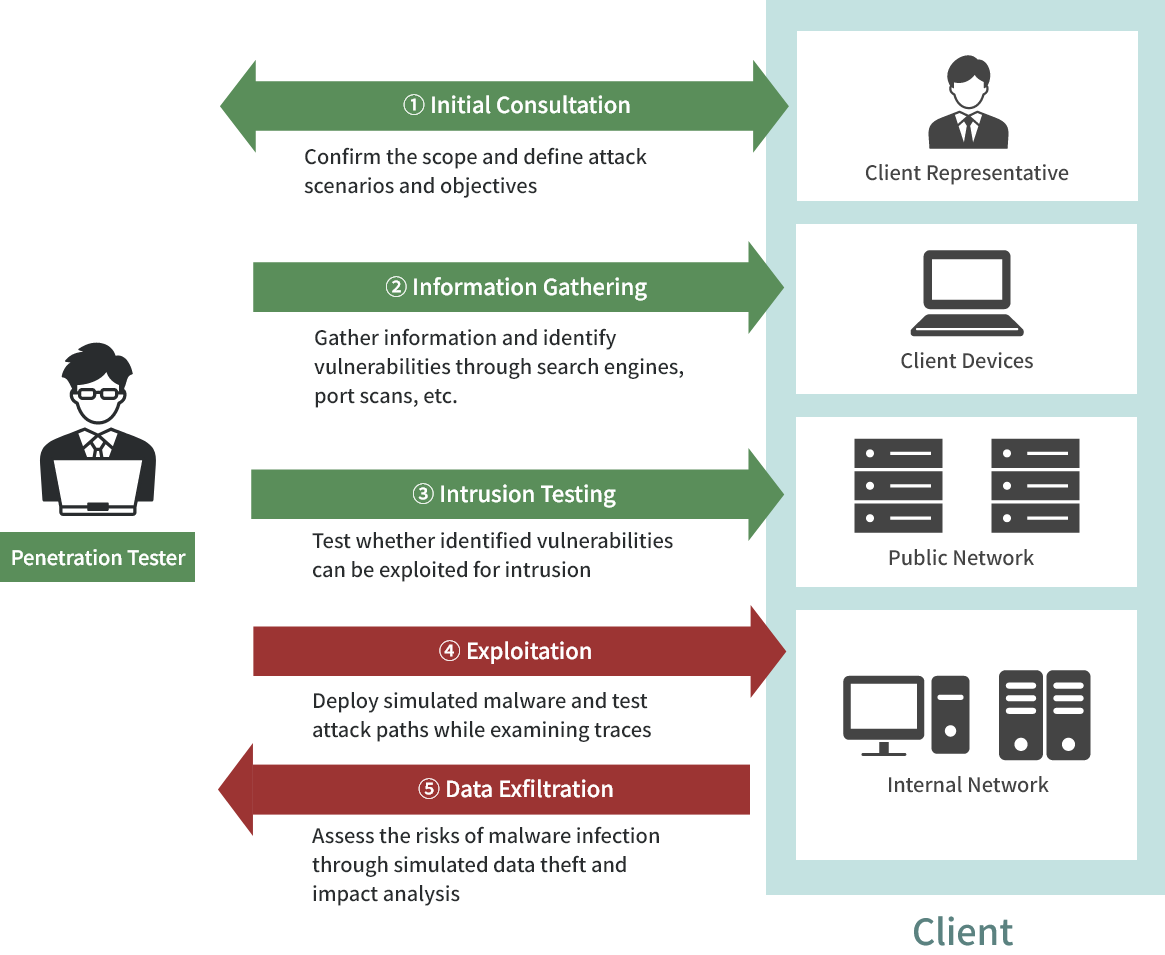
| 1. Preliminary Review | We conduct interviews and preliminary research based on your system environment and security maturity to determine the scope and priority areas of the penetration test. At this stage, we confirm the systems to be tested, the network architecture, and any required access permissions, preparing for efficient and effective testing. |
|---|---|
| 2. Attack Scenario Development | We develop realistic attack scenarios based on the characteristics of your systems and current industry trends. Detailed scenarios consider potential intrusion paths, the data an attacker might target, and the potential financial impact. |
| 3. Test Execution | Using real-world attack techniques, we conduct penetration testing based on the scenarios developed. We apply a multifaceted approach—including external intrusion, internal network attacks, and web application vulnerability testing—to identify potential risks. |
| 4. Results and Remediation Recommendations | We analyze the test results, evaluate the severity of identified vulnerabilities and risks, and recommend specific remediation measures. The report includes details of each vulnerability, practical steps to prevent recurrence, and long-term measures to minimize risk. |
| 5. Follow-Up | We verify the implementation status of recommended improvements and provide retesting or additional advice as needed. Because vulnerability assessments and penetration tests should be conducted regularly, Infosec Advisory supports continual security improvement. |
Deliverables
At the conclusion of the penetration test, we provide a comprehensive report and recommendations to help you effectively remediate the vulnerabilities identified.
- List of Identified Vulnerabilities and Remediation Plan
We provide a list of identified system vulnerabilities, classified according to their exploitability and potential impact on your systems and business, together with a remediation plan. - List of System Changes Made During Testing
The test protocol documents the equipment and tools used, the areas examined, and the issues identified. It also includes actionable recommendations for resolving the security issues discovered.
The report provides an overall rating and remediation priorities based on assessment criteria such as those below.
Overall Rating
| Grade | Assessment Criteria |
|---|---|
| A | No vulnerabilities were identified. Alternatively, only findings that are not realistically likely to have an impact at present were identified. Security controls are considered robust. |
| B | Vulnerabilities with only minor impact were identified, such as issues that require complex conditions to exploit or disclose information that could assist an attacker. A reasonable level of security controls is considered to be in place. |
| C | Numerous vulnerabilities or vulnerabilities that could cause significant harm if exploited by someone with a degree of technical expertise were identified. Planned remediation is required. |
| D | Vulnerabilities that could result in serious harm were identified, including data breaches or the alteration of critical information. Immediate remediation is required. |
Vulnerability Severity Ratings
| Severity | Required Action | Assessment Criteria |
|---|---|---|
| Low | Monitoring is required |
|
| Medium | Remediation is required within approximately six months |
|
| High | Prompt remediation is required |
|
Web Application Vulnerability Assessment
Rating Scale
| Rating | Description |
|---|---|
| Informational | Provided for informational purposes only. |
| Low | Exploitation of this vulnerability generally has a limited impact. |
| Medium | Exploitation of this vulnerability generally has a moderate impact. |
| High | Exploitation of this vulnerability generally has a significant impact. |
Penetration Testing Rating Scale
| Rating | Description |
|---|---|
| None | No actions could be performed on the target host or service using either administrator or standard-user privileges, and no information outside the service could be obtained. |
| Caution | Information outside the service could be obtained from the target host or service; however, no actions could be performed using administrator or standard-user privileges. |
| Warning | Information within the service could be obtained from the target host or service; however, no actions could be performed using administrator or standard-user privileges. |
| Critical | Actions could be performed on the target host or service using standard-user privileges, but not administrator privileges. |
| Emergency | Actions could be performed on the target host or service using administrator privileges. |
We tailor our services to your specific needs. Call us today to discuss how we can help.
